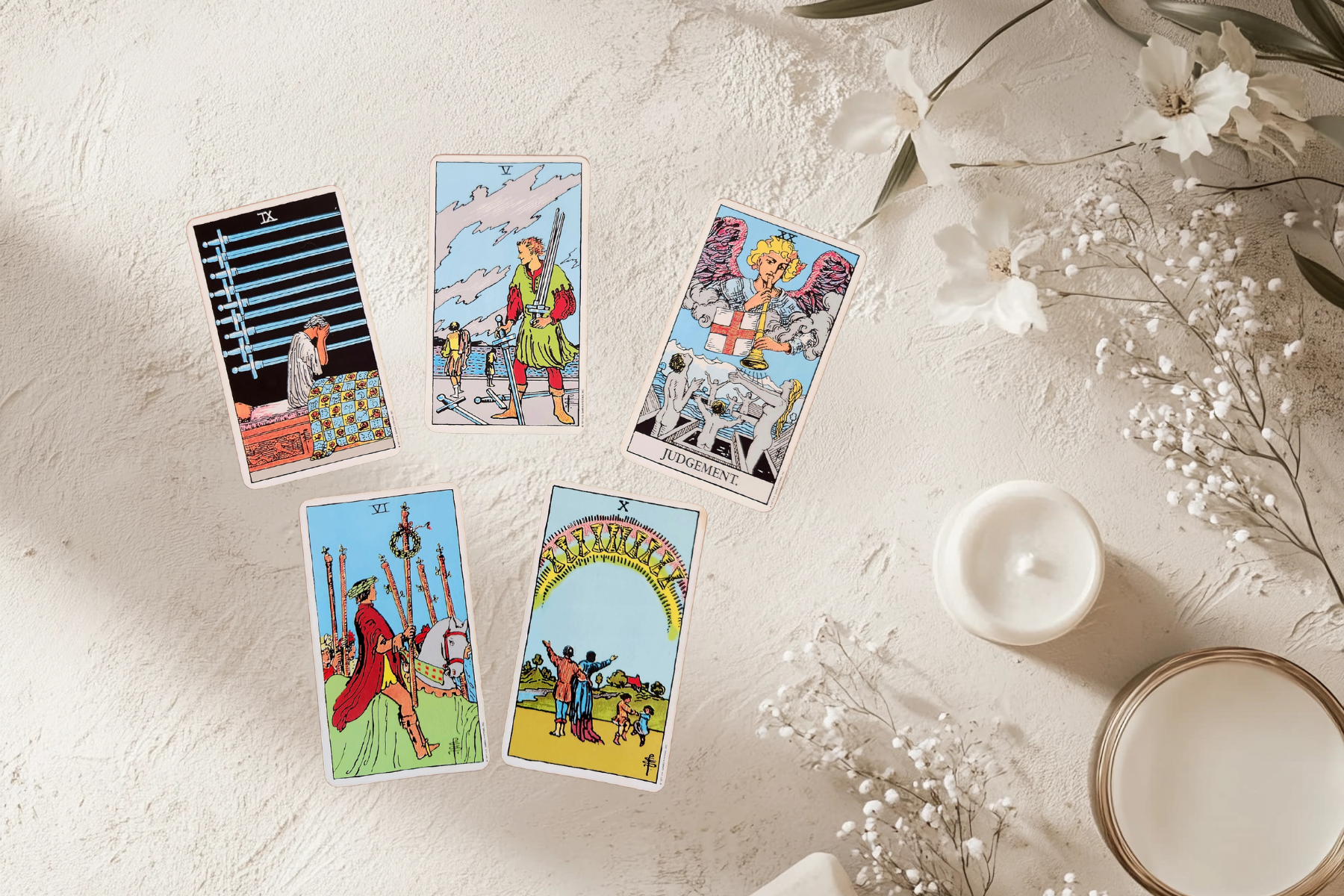

Cards Drawn
Past: 9 of Swords
Present: 5 of Swords
Future: Judgement
Soul Expression: 6 of Wands
Context: 10 of Cups
ESTIMATED READING TIME: 7 MINUTES
💓 Final Pulse
If every inch of ground has to be fought for, eventually the fight becomes the problem.
There comes a point when thinking harder stops producing better answers.
You can go over the same problem from every angle, replay every conversation, assess every possibility and still end up exactly where you started. The mind gets caught in a loop because it believes there must be an answer somewhere in the thinking. If you analyse it enough, worry about it enough, prepare for enough possible outcomes, eventually you will find the thing that makes everything okay.
Except you don’t.
The stress builds because the answer refuses to appear.
And when you have been under that kind of pressure for long enough, it changes the way you engage with the problem. You stop simply trying to solve it and start fighting it.
You push harder. You defend your position. You try another plan. You try to get people on board. You refuse to give up ground because you have already fought so hard for every inch of it. The fight starts feeling necessary because the alternative feels like defeat.
But there is a question you need to ask yourself here.
Is what you are fighting for actually getting you the result you want?
There is a reason the phrase choose your battles wisely has survived for so long.
Not every battle needs to be fought. Not every obstacle needs to be conquered. Not every disagreement needs to be won. And winning at all costs does not always result in winning.
You can get what you wanted and still lose something in the process. You can prove your point and damage the relationship. You can keep pushing a plan long after everyone else has lost interest. You can defend something so aggressively that you end up alienating the very people you hoped would support you.
You can fight hard enough to crack the walnut. But if you used a sledgehammer, you probably destroyed half the kitchen as well.
That is the problem with fighting from stress.
The response becomes bigger than the thing you are responding to.
You are no longer dealing only with what is happening now. You are dealing with everything the situation represents. Every previous disappointment. Every fear that you are going to lose something. Every memory of having to protect your ground. Every experience that taught you that nothing comes easily and every inch has to be fought for.
Eventually the fight becomes its own pattern because you stop asking whether something is worth fighting for and start assuming that everything requires a fight.
And that is what needs to be looked at now.
This is not about becoming passive, losing your ambition or deciding that nothing is worth fighting for. It is about recognising where fighting has become automatic. Where difficulty immediately makes you push harder. Where resistance convinces you that more force is required. Where you are still defending, proving, pushing and holding your ground without stopping to ask whether any of it is actually helping.
This is the present decision point.
Can you tell the difference between something that genuinely deserves your determination and something you are fighting simply because you have become accustomed to fighting for every inch?
Because if you can recognise where the fight itself has become part of the problem, you create the conditions for something different to happen next.
That is where release becomes possible.
Longstanding problems can begin to resolve. A business that has struggled can start picking up again. Your health can improve after a difficult period. Finances can begin to recover. A relationship can change after months or years of strain. A project that seemed permanently stuck can start producing results.
This is where resurrection comes in.
What has felt stuck, depleted or beyond repair may not have reached the end of its story. It may have been operating under conditions that kept producing the same disappointing result. Once those conditions change, you get to see what is genuinely still viable.
Some things can recover. Some can begin working in a different way. Some can finally show you that they were never the right thing to keep fighting for in the first place.
That release can put you onto a different track because you are no longer using all your effort trying to force life into the shape you had already decided it should take. You can begin recognising what has resonance, what still has life in it, what is calling for your attention and what feels worth committing yourself to now.
That is very different from relentlessly trying to revive something because you have already invested so much in it.
One is determination. The other is fighting reality. Once you can tell the difference, your ambition becomes useful again.
You can organise yourself around success rather than around struggle by looking at what truly worked, what people responded to and where your effort produced a genuine result.
Look at what you did well and what became easier once you stopped trying to make everything work.
Success leaves evidence. Pay attention to it.
There is a profound difference between winning because you defeated something and winning because something actually worked. One leaves you looking around at the casualties. The other gives you something worth building upon.
And this brings us to the bigger question underneath all of it.
What if success is not how much you managed to fight for, but how much of your life finally starts working?
Your work. Your relationships. Your home. Your finances. Your health. Your friendships. Your ordinary days. Your corner of the world.
Success cannot only be measured by what you achieved, defended, proved or refused to lose.
At some point you have to ask whether you actually like the life all that effort has produced. Because happiness does not live only in the big win. It is also the feeling of looking around at your life and realising you like what is here.
You like the people in it. You like where you live. You like the work you are doing. You like the direction you are heading. Your corner of the world finally feels like home.
That is a very different definition of victory. And it may require you to stop fighting long enough to recognise that life is trying to give you one.
⭐ End of Week Guidance
The smartest fight is the one most likely to get you the result you want.
Pay attention to where you are still treating difficulty as proof that you need to fight harder. Before you push, defend, explain, prove or try another plan, ask yourself whether the fight is actually producing the result you want.
Some things need determination, some need a different approach, and some need to be cut off completely. No more fighting in a bid to rescue them, no more trying to make them work because you have already invested so much.
Choosing your battles wisely means putting your effort where it has the best chance of producing the result you want.
Then look for evidence of what is actually working. Notice where your effort is getting a response, where something feels viable again, and where life is beginning to open in a more satisfying direction. Let that information guide what you give your energy to next.
🌙 Ending the Week Well
You do not need to turn this into another thing to fix.
If you recognised yourself somewhere in this week’s message, that is enough. You do not need a plan, a strategy or a list of everything you are going to do differently from Monday morning.
Just notice where you have been fighting harder than the situation required, and let that awareness come with you.
The point is not to become better at fighting.
The point is to stop making everything a fight.

Comments:
share