

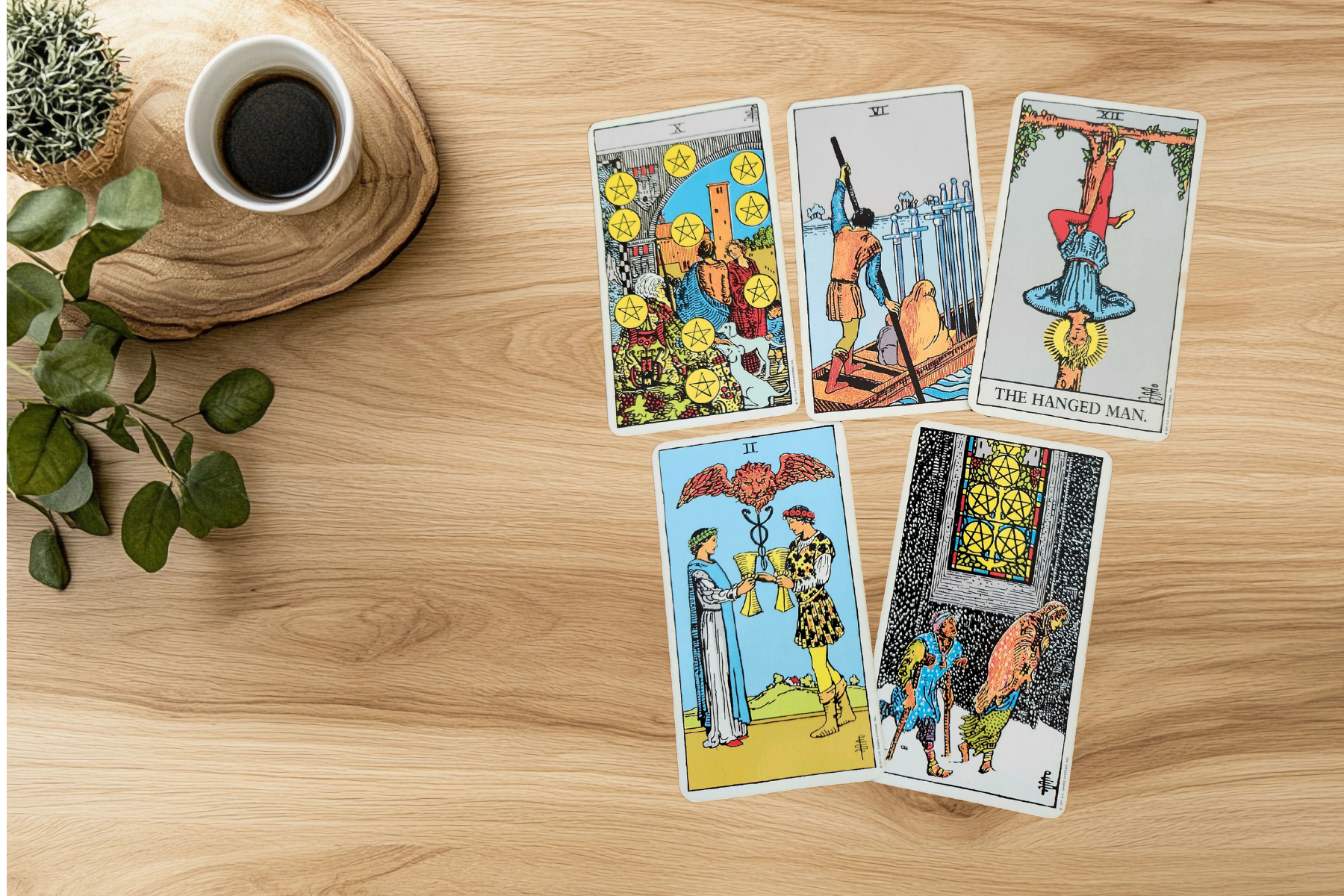
Cards Drawn:
Past: 10 of Pentacles
Present: 6 of Swords
Future: The Hanged Man
Soul Expression: 2 of Cups
Context: 5 of Pentacles
ESTIMATED READING TIME: 6 MINUTES
❤️ Weekly Pulse
What changes when you stop mistaking inheritance for identity?
The Ten of Pentacles in the past position points to the legacy you inherited. Family culture. Rules. Beliefs. Expectations. Emotional habits. What was acceptable, what was shameful, who was blamed, how conflict was handled, what love looked like, what safety required.
So the underlying question becomes:
Are you living according to what is true for you, or according to what was handed to you?
And then the Six of Swords as the present card is not simply leaving a difficult situation behind. It is leaving a way of thinking behind. There has been enough reflection now to recognise, “Hang on, I learned this. I inherited this. This reaction may be mine in the sense that I perform it, but it did not necessarily originate with me.”
The Hanged Man in the future position then feels almost inevitable. Once you recognise the conditioning, you cannot keep seeing the situation from exactly the same angle. The automatic response starts losing some of its authority. You create that tiny piece of space between stimulus and reaction where you can ask, “Is this actually what I think, or is this simply how I learned to respond?”
The Two of Cups as Soul Expression takes it beyond personal introspection. This is not just about becoming a more self-aware person in isolation. The point of dismantling the inherited pattern is to change how you meet other people. How quickly you assume hostility. How much room you give someone else to be imperfect. Whether disagreement automatically becomes rejection. Whether you can stay connected without reproducing the relationship dynamics you were taught.
And then the Five of Pentacles is fascinating as context because it suggests that some of the alienation, exclusion, loneliness, or feeling that the world is somehow against you can actually be created or reinforced by those inherited patterns.
Not because somebody consciously chooses isolation, but because the inherited response can produce it.
You expect rejection, so you protect yourself.
You expect blame, so you become defensive.
You expect somebody to be wrong, so you arrive ready for conflict.
You expect not to be understood, so you withdraw.
And eventually the pattern seems to confirm itself.
That gives the Five of Pentacles a much richer role than simply, “You have felt left out.” It becomes the consequence of carrying an old relational inheritance into present-day interactions.
We went from “The future is unknown, not unsafe”, where the pressure to anticipate difficulty began to loosen.
Then “Being safe enough to acknowledge something hurt”, where we looked at protective strategies that had outlived their usefulness.
Then the Final Pulse, “What becomes possible when you stop smothering yourself “ moved through the pressure collapsing, the view clearing, and emotional stability returning.
And now we arrive here.
If the pressure has lifted enough for you to see clearly, what are you now able to recognise was never really yours to begin with?
This isn’t about “letting go”.
This is generational evolution because you are recognising the inheritance beneath the reaction.
✨ Guidance for the Week
This week, notice the reaction before you judge yourself for having it. The point is not to become perfectly self-aware overnight. It is to become curious about what happens automatically.
When something triggers irritation, defensiveness, withdrawal or the expectation of rejection, ask yourself where that response came from. Is it appropriate to what is actually happening now, or does it belong to an older pattern?
You do not need to reject everything you inherited from your family. Some of it will be valuable. Some of it will have helped you survive, belong, connect or make sense of the world.
But inheritance does not have to become instruction.
The Hanged Man asks you to create enough space to see the situation differently before repeating the response you already know. The Two of Cups reminds you why this matters. Every pattern you understand gives you more choice in how you meet another person.
And if you catch yourself doing the old thing again, that does not mean nothing has changed.
Recognising the pattern while it is happening is part of changing the pattern.
This week asks you to notice where you finally have a choice.
🌿 Life Area Breakdown
❤️ Relationships
Inherited patterns can show up most clearly in relationships because other people give them somewhere to land. Notice where you expect rejection, criticism, conflict or misunderstanding before it has actually happened. This is an opportunity to respond to the person in front of you rather than the relationship dynamics you learned elsewhere.
💼 Work & Purpose
Old beliefs about success, responsibility, authority, money or what you are “supposed” to do may be becoming easier to recognise. Question whether the expectations driving you still belong to you. A different perspective may reveal that some of the pressure you have been carrying was inherited rather than chosen.
💰 Money & Resources
The Ten and Five of Pentacles bring inherited attitudes around security, scarcity and financial safety into focus. Pay attention to the beliefs underneath your money decisions. Are they based on your current circumstances, or on what you learned about risk, lack, stability and having enough?
🧠 Personal Growth
This is where the Hanged Man becomes especially useful. You are being given the opportunity to see an old reaction from a completely different angle. The more clearly you can see what was inherited, rather than chosen by you, the easier it becomes to decide what still fits and what no longer needs to define you.
⚡ Three Micro Moves for Momentum
1. Catch the automatic response.
When you notice yourself becoming defensive, irritated, withdrawn or expecting the worst, pause long enough to ask, “Is this response about what is happening now, or is it something I learned?”
2. Check the inheritance.
Choose one belief, expectation or reaction that keeps repeating and consider where it came from. You do not have to reject it simply because it was inherited, but you do get to decide whether you still agree with it.
3. Choose the response that belongs to you.
When the familiar pattern appears, experiment with responding from what you know now rather than what you were taught then. Even one different response begins to separate inheritance from identity.
🪞 Reflection Prompt
Where do you notice yourself automatically reacting in a way that goes against your own grain?
What changes when you recognise that response as learned or inherited, rather than something you have to keep acting on?








Comments:
share